CPH:DOX THE CONFERENCE DAY 1

5 Days exploring film, technology, science & art @ CPH:DOX in partnership with Documentary Campus.

Theme Day 1: Art, Technology & Change

The film industry is changing as fast as it can (not very), to keep up with audience habits. New tech however, is lean and flexible by nature, partly because creators are still struggling with finding the right delivery mechanisms, but mainly because it’s all new enough that the possibilities are still pretty open.

Case in point, one wonders if Watson might put me out of a job some time soon.
01

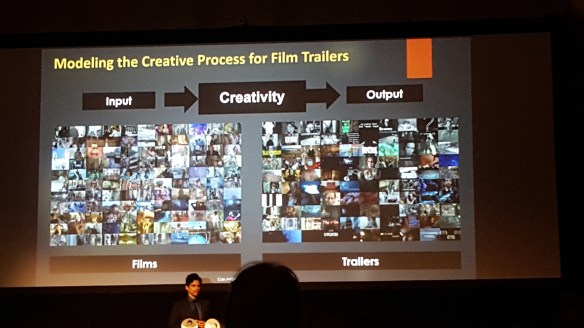
Brainchild of the Multimedia and Vision team from the T. J. Watson Research Center at IBM, WATSON is AI that’s started putting trailers together.

An AI film trailer, put together by AI. Smart.

John R Smith, IBM Fellow and Manager of the department, asked the question “Can artificial intelligence be creative?” A terrifying question for anyone in the business. We can sort of tolerate the idea that AI might be ale to analyse meaning from data, maybe even reach certain conclusions as well. But to mimic the creative process? The mysterious thing that justifies our existence and careers because it can’t be defined? That can be learned?

Not quite yet, but the wheels are in motion.
 

02

“For me creativity in science begins with method” says Smith. In other words, once you define a system of learning, you have a shot, if you follow it through.

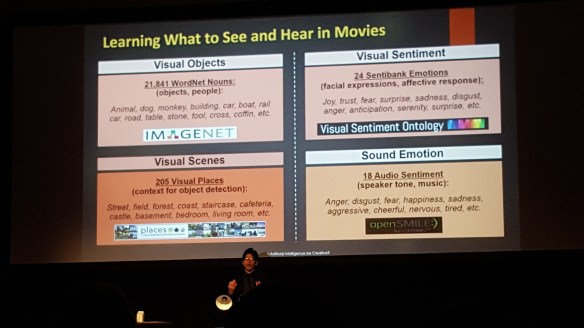
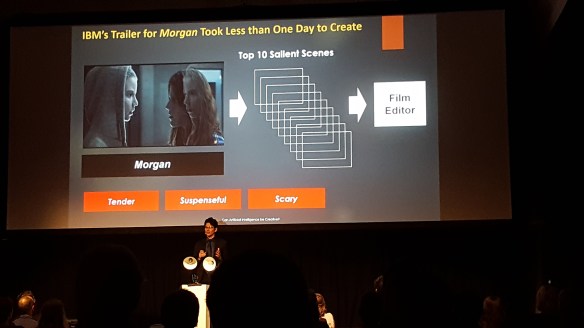
Once films have been input into WATSON (in this case horror films), it is taught how to recognize what it sees on the screen: laughter, a car, the color red, the sky, etc. The same is done for trailers for those films, so it can evaluate what makes a good one. Then another film is through WATSON, and it tags everything it recognizes into its database. It files the information and can retrieve specific shots at will. With all the footage tagged and filed, It then evaluates what footage would be appropriate for a trailer, based on the reference films’ relationships with their trailers. In effect, it uses “experience” as a way of deciding what shots to choose. An editor does the creative work afterwards, but the selects come from WATSON.
 

03

And out of 10 shots selected by the beast, the editor agreed with 8 of them. Staggering.

If the method really is the beginning of creativity, I’d better start thinking of getting some AI implants or something. (to be fair, it did give me fantasies of being in my edit suits and saying “Watson, pull everything with a red flower in it.”

____________
04

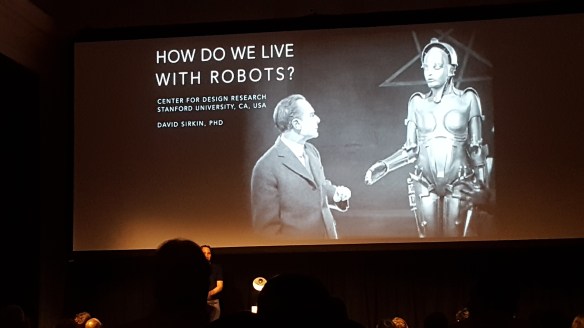
Staying in the realm of AI and automation, We’re still deciding what our relationship is with the things we create. David Sirkin’s talk How do we live with robots was a fascinating look at some of the user experience design research being done at Stanford.

Driverless cars, a living room ottoman, and even trash cans were all subjects in the department’s heavily documented research.

The amazing thing is how quick we are to assign personalities to the robots that we meet. A rolling ottoman places itself under a subject’s feet. When it later moves, the subject thought that he had done something to somehow upset the ottoman. Another pets it like a dog when it moves. Or desk drawers that respond to the patterns of the person sitting there. Sometimes they go with the flow, and sometimes against it. One desk even started “chuckling” when the subject dropped something (drawers quickly going in and out like a wheezy guffaw). Subjects’ reactions are measured, but always engaged in trying to understand the machine’s behavior.

We’re a long way from cylons, but what’s clear is that we have to be aware of how we interact with the things we create, lest we risk them becoming our overlords.

___________

Back in a slightly more 2D world we heard from the realm of impact comics from Ram Devineni, Producer/Director at Rattapallax.

His talk was Augmented reality activism. His project, Priya’s Shakti, is an AR digital comic, that also works as an augmented reality piece that for once is actually targeted at the slums where violence against women, including acid attacks, are at their highest. “We looked at female characters from American comics (huge breasted, scantily clad), and said Fuck That! We spent lots of time creating a new kind of natural hero, steeped in Hindu culture.”

The comic itself is wonderfully different from the usual fare. I’m still a bit unclear about the impact of the AR components, but you can check them out yourself and see what you think.

At the very least, Yay! A positive female role model, and a project that understands that the problem needs to be tackled as a men’s issue (the perpetrators), not a woman’s.

__________

Ah. Closeness to home, with a project from Montreal’s Dpt.

Paul George presented The Enemy, a VR / AR experience by war photographer Karim Ben Khelifa. He filmed combatants from opposing sides (Israeli / Palestinian for example), answering the same questions and speaking of the same things: Who is your enemy? Have you ever killed your enemy? And so on. In the VR space, users are between the 2 combatants, standing face to face. Looking at the Israeli soldier, he gets into what makes an enemy his enemy, and the Palestinian does the same.

“We have more in common than we have differences” says George. We fear the same things, respect most of the same values. If we could listen to each other… maybe we could hear each other.”

It’s always difficult to judge how a VR piece functions unless you’ve been strapped into the headset, but the theory behind the project is, I think, sound. Strip away the ideologies and politics and at heart we’re all ultimately human. A Jewish friend of mine with an Israeli girlfriend once said to me “ I can’t move to Israel. In theory you and I could end up shooting at each other (me being Syrian).” The weirdest pre-disposition to violence and warfare seems hardwired in, but it’s still ultimately learned. Maybe going through the VR “empathy machine” can bridge the gap that diplomacy and proximity can’t.

__________
 

05

Ending the day was creative technologist Eric Magnee’s Smartphone orchestra. I don’t want to spoil it for you so check it out here.

________

SCREENINGS
Liberation Day


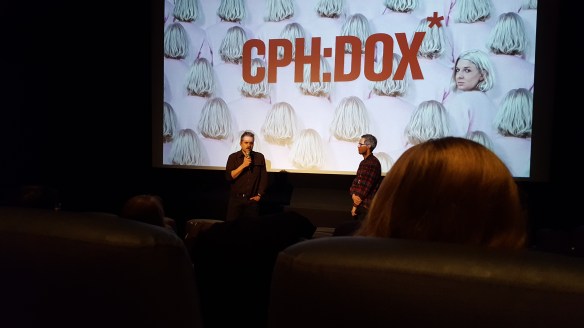
20170320_231809I had a tiny hand consulting on this project, but it was my first time seeing it on the big screen. What can I say; it’s a great film! Director Morten Traavik was there for a good Q & A afterwards, and all walked away satisfied.

One screening left Sunday the 26th at 9:30, at the Nordisk Film Palads cinema.

________

Coming up: The Conference coverage continues, More film, more industry, and an interview with Matt Johnson of The The fame, on the occasion of his new documentary The Inertia Variations, screening with Q & A Screenings


CPH:DOX DAY 2

MACHINES

Screen Shot 2017-03-20 at 19.56.08

I spent a year editing How It’s Made, exhaustively exploring the rhythm of machinery and human interaction. Working on the program was about as assembly line a job as I ever had too, so my psyche was nicely aligned to the content, until I couldn’t handle watching one more piece of sheet metal get pressed into the form of a sink, or another injection mould endlessly pump out toothbrush stems. I ended up getting my kicks imagining editing an hour long assembly of… something, never revealed except in a series of extreme close ups, made of plastic, wood, stone, every material imaginable.

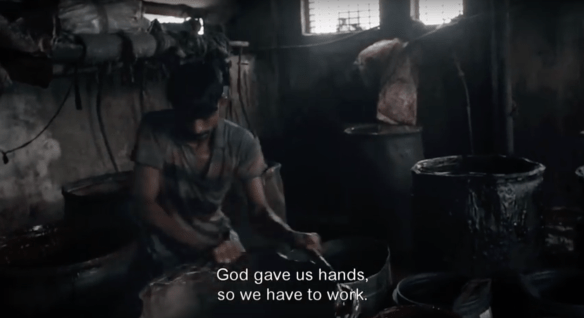
What the title of Rahul Jain’s Machines, screening at CPH:DOX refers to gets blurry over time. Is it the coal ovens, silk screen printers and rollers that never seem to stop churning out textiles, or the people stoically operating them, working back to back 12 hour shifts to support their families? The distinction is made all the more slippery by the fact that almost nobody speaks in the film. This isn’t manual labor buoyed by friendly chatter, it’s mechanical, silent work done by men who look dead behind the eyes.

I’ve got a soft spot for the quiet, lingering doc that hypnotizes me. Having the time to submerge into simple moments make those moments stay with me longer, play out in my head, get re-evaluated depending on context. The thing I tell creators the most in trailer workshops is to let their scenes breathe more. Give us a chance to be there.

I re-imagined the film as an interactive piece, somehow immersing the viewer in the smell and sights and sounds of that hellish workplace. It wouldn’t require any more talking, just a different frame, with so and so’s name, from such and such a province, however many km away. How many kids they have, how many hours a week they have to work, what their life expectancy is after exposure to chemicals and the relentless wear and tear of heir brutal pace.

Not for the feint of heart, but well worth your time.


Less so the first batch of VR on display at the Charlottenborg Kunsthal. The impact series let me down. I spent most of the time wondering why the pieces were VR. Trevor Snapp’s We Who Remain was apparently about the people of the Nabu mountains in Sudan, but it was edited like a film, one with narration and graphics and multiple characters and no clear storyline. I spent real time trying to figure out what the film was about. Not a promising sign.

Screen Shot 2017-03-20 at 20.15.22

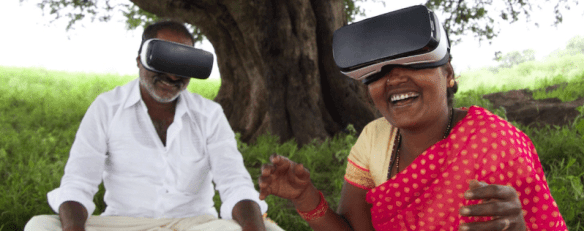
Jayisha Patel’s Notes to My Father had more going for it. From the Indian heartland a young woman is trafficked into the sex trade, but most of the film is spent at the family abode. Gorgeous rice fields are seriously heightened in 3d, and there are some genuine moments where time is allowed to pass quietly, slowly, where you can be where you are. But narratively the piece gets muddled, and, like We Who Remain, I struggled to figure out what the piece was really about.

Honestly people, abandon the idea that VR should be like film. Figure out what the language is.

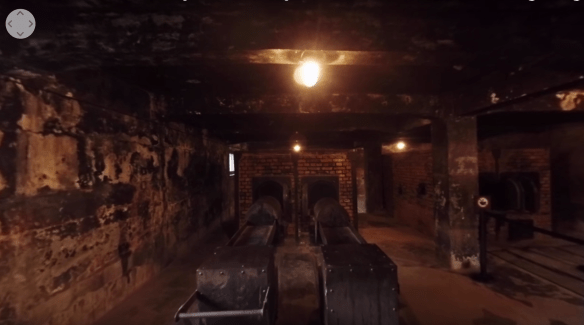
There’s one moment of Inside Auschwitz where I feel the shivers up my spine that I should: when we’re at the ovens, and one can look around, take in the evil, where it’s quiet enough to let the awfulness wash over you. If the piece had been only that it would have been 50 times more powerful.

Screen Shot 2017-03-20 at 20.19.42

A conversation about storytelling today was about the unique possibility of doc to let contradictions tell the story, to trigger the audience to feel and think what the subject does, that gives doc the narrative advantage that it has over fiction. VR is well on the way to finding its edge, but that means letting go of cinematic tropes.

VR is just a kid, folks. Let it become the grown up its meant to.

CPH:DOX DAY 1 (FOR ME)

20170318_131810

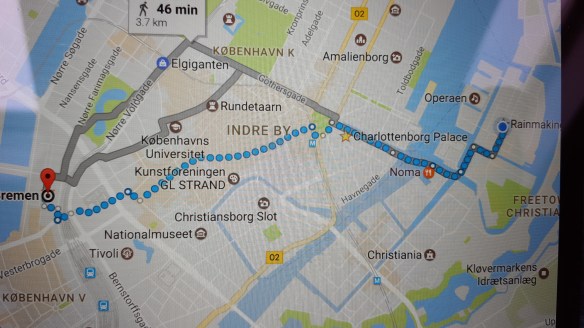
Copenhagen is bigger than it looks, depending on what you’re after.

Which is my way of copping out of not having gotten more done today.

I’m sooo looking forward to the VR content this year. It’s broken down into simplistic, but useful categories, and all of it looks fascinating.

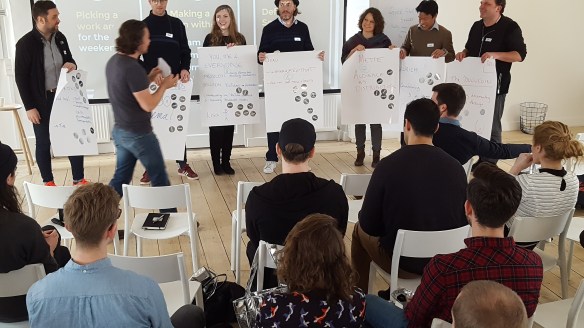
The first bit of the day was spent at the Propellor lab: a genuine movement towards finding new strategies for delivering content to audiences, from the production stages all the way to that after-sex cigarette stage of “wow, that was amazing(or a let down).

20170318_132623

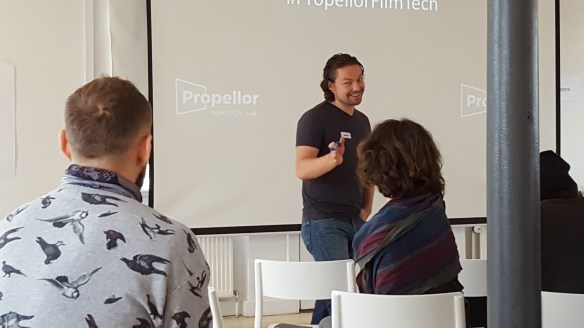
Led by Daniel Johnsen and Erwin M. Schmidt, the format is fast and loose. And demanding. If you’re a participant or observer there’s no holding back. You have to tell everyone your idea for a business model so that your peers can tell you everything that’s right / wrong about your it, and make it better.

The pace is fast, and it seems like everyone is digging deep in their guts, to quickly pull out what’s most important. Will that bring out everyone’s best? Tomorrow will tell.

20170318_124005

The pitches, atThe Rainmaking Loft Copenhagen On Sunday, are open to all. If you’re interested in the thinking that’s drawing us forward, or want to pull that apart, be there!

20170318_144945

Everyday life feels pretty complicated. Until you watch lifeless infants being pulled from mountains of rubble. Feras Fayyad‘s Last men in Aleppo drives a dagger into your heart over and over, making you hope for numbness, so you don’t have to feel the hurt so much anymore.

There are lots of Syria projects around right now; documentary, VR, journalistic and otherwise. But I can’t think of another that made me feel quite so much the “normalcy” of war and death. The “white helmets” whose job it is to save people drowned in the fallout from bombs are just people, like the mechanic you used to work with or the teenager who used to bug you by whipping a hockey puck into your garden or the guy who used to be your pharmacist. Stuck in extraordinary circumstances and determined to do right by their city, by their neighbors, by their own consciences, they don the iconic white helmets of Syria’s saviors and hurl themselves into the most dangerous situations imaginable, on the outside chance that a miracle will happen, and one of the people they can actually save someone. As a Syrian, it makes me ashamed for not being one of those white helmet guys.

Collaborator Steen Johannessen was at yesterday’s screening, while Fayyad was attending a premiere in Switzerland.

20170318_164606“We had a little over 200 hours of footage to go through, plus a huge amount of broadcast archive. There are a million Syrian stories to tell, and every decision was measured. This story is important because it brings us into the day to day reality of the people left behind. Abandoned.”
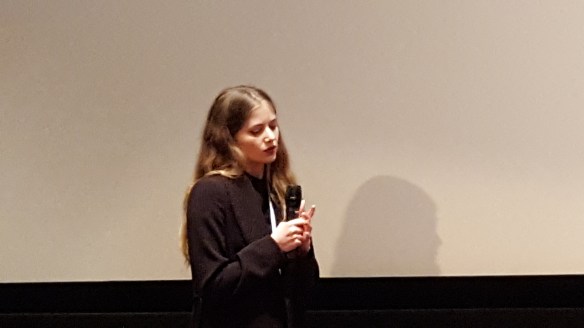
Not for the feint of heart, but required viewing for anyone who feels the shameful abandonment of an entire people by the international community. Rightful winner of the grand jury prize at Sundance.

20170318_225643

Craigslist Allstars is a whole different kind of beast.

Filmmaker Samira Elagoz made the film as her thesis project, and it got enough attention to get played at the fest. She posted an ad in Craiglist hoping to be invited into strangers’ homes, and document their encounters. I suppose the kink should have been obvious, but I was more interested in the DIY approach of setting up the concept and being invited inside someone’s personal space.

“The sex, in hindsight, was probably the most likely outcome. But that wasn’t why I started making the film. But not a single woman answered my ad, and the men.. are men.”

Two screenings left at the fest. If you want to peel back some of those mysterious doorways, check it out.

SHE WORKS HARD FOR THE MONEY (IWD EDITION)

superheroThe old cliché about the day of your kids’ birth is true: it’s a doozy.

My kid happened to be a girl, which made it a gender-specific doozy. It’s just a little bit different than the blessing of a boy, and in my case it suited me to a tee.

So in those moments when I drop the ball when it comes to gender issues, I feel like a pretty lousy dad. Especially in a world where a douche bag like… you know who, gets away with “locker room talk” and the assumption that being a powerful man gives him rights over anyone’s privacy. There are plenty of dark stories that start from the same kind of innocuous jackass.

I’ve got this thing for documentary films, and in particular, I’ve worked on a whole packet of films about women, usually fighters, struggling to make the world a better place, at least for women. My mom is one of my heroes, so I guess I just never understood why one gender would have power over another. It made no sense to me. Lower salaries, shorter professional shelf life, less access to higher positions: I always felt like it made no sense. So now, with a girl to nurture and raise, I see it as not only as an interest of mine, but a responsibility.

Last year alone I got to work on 3 powerful films that tackled women’s stories head on;


Biljana Turturov’s When Pigs Come


Nima Sarvetsani’s Prison Sisters


And my personal favorite, Koen Suidgeest’s Girl Connected

Koen locked me in an apartment in Leiden, without food or water, for a month last spring. We’d met tutoring at Lisbon Docs a couple of years earlier and have stayed in touch ever since. When he pitched me the project and asked me to come to Holland to edit the film I was thrilled.

For now you can watch it the whole film here!

Like me, Koen is surrounded by estrogen, with his partner, 2 daughters and a dog. He’s as empathetic a soul as I’ve met in the doc world, and he (and I) liked that I wanted to be left mostly alone with the material, so I could get as close to the girls in the film as I could. He’d come to the prison cell every day or every two days, and we’d look at where it was going and make decisions from there. It was a race to the finish line, but a fantastic process, and I’m super proud of the final product.

I had a chance to catch up with Koen and ask a couple of questions about his thinking around the project. (and he didn’t really keep me without food and water in Leiden.)

Me: What drew you to Girl Connected?

Koen S: My entire body of work is about people who are underserved, or in a disadvantaged position, and despite that are standing on their feet, progressing and making the very most of their lives. Since my work often involves children’s rights, women’s rights and themes of motherhood, generally in areas of poverty, Girl Connected is a natural issue/topic.

I wanted to make a film, along with ITVS producer Christi Collier, about girls who are fighting against the tide, upstream to what their culture expects from them.

Me: And how did you come to choose those particular girls?

K.S.: I worked with the country coordinators of this educational program, Women and Girls Lead Global. They often suggested stories and characters to me. Often, these stories had already happened and I wanted to film something that was happening currently.

Me: Always a better bet for a “motion” picture.

K.S.: So a lot of stories were put aside. Some of the interesting ones I ended up skyping with. Or if that wasn’t possible, I was sent some video footage through a local journalist. And we chose based on that. There were sports related stories from several countries, but I only wanted one sports story. So we settled on Ayesha. What was important was that there was variety.

Me: Must have been a hell of a process choosing someone based on their skype presence.

K.S.: Oh yes, it was a little risky. But it worked out very well.

Me: I think there’s a remarkable variety of girls, given that they mostly come from similar socionomic backgrounds.

K.S.: Indeed. And I love that we were able to tackle five such important but also different themes. Child marriage, teen pregnancy, leadership, sports & self esteem, creativity

Me: Does it ever enter your head that you’re a guy covering women’s stories? I know my own answer, but I’d love to hear yours. There is often controversy around men telling women’s stories “why can’t a woman make that film? It’s part of the problem” type of thing.

K.S.: Well, there are many women covering amazing women’s stories as well. Of course I am aware of being a man, but I can’t really change that, can I? And I don’t know if I need to be ‘like’ the subject of the film to be able to represent it better. Sometimes it’s actually better to be more of an outsider. And that counts for many differences between maker and subject: films about poverty, about armed conflict, about drugs… whatever.

Me: Yeah, I agree. It gives you that “fish out of water” in the sense that your own journey of discovery is part of the revelation. I think it takes men to stand up and say important women-positive stuff as well. Make it less us vs them.

K.S.: Totally true. Sometimes it takes a man to change a man’s mind.

😉

My skype starts in 4 mins 😉

Me: Alright dude. Thanks a million!

K.S.: My pleasure, of course! And talk soon I hope.

Me: CPH:DOX maybe?

K.S.: Maybe…


A cryptic sign off, but we managed to cover the guts of the question, so…

_______________________

I guess what I’m trying to say is happy international women’s day.

But I guess I’m also wondering why, in 2017, it would still be necessary. I would have hoped we’d be past this crap already, and diversity would simply be a fact of life instead of an exception, and guys like the one with the orange hair and skin wouldn’t be where they are.

But they are.

So let’s do what we have to to shut them down, so that eventually this can be known as international human’s day instead.

For my part I’ll keep cultivating projects that tackle women’s rights.

Maybe I’ll even start wearing a pussy hat.